The bandsaw blade wizard
Read the published reference tables the bandsaw blade wizard computes from.
Updated 23 September 2026
On this page
- Why
- A blade recommendation you can trust names the chart behind it.
- How
- The tables below are the engine's own data, exactly what it reads.
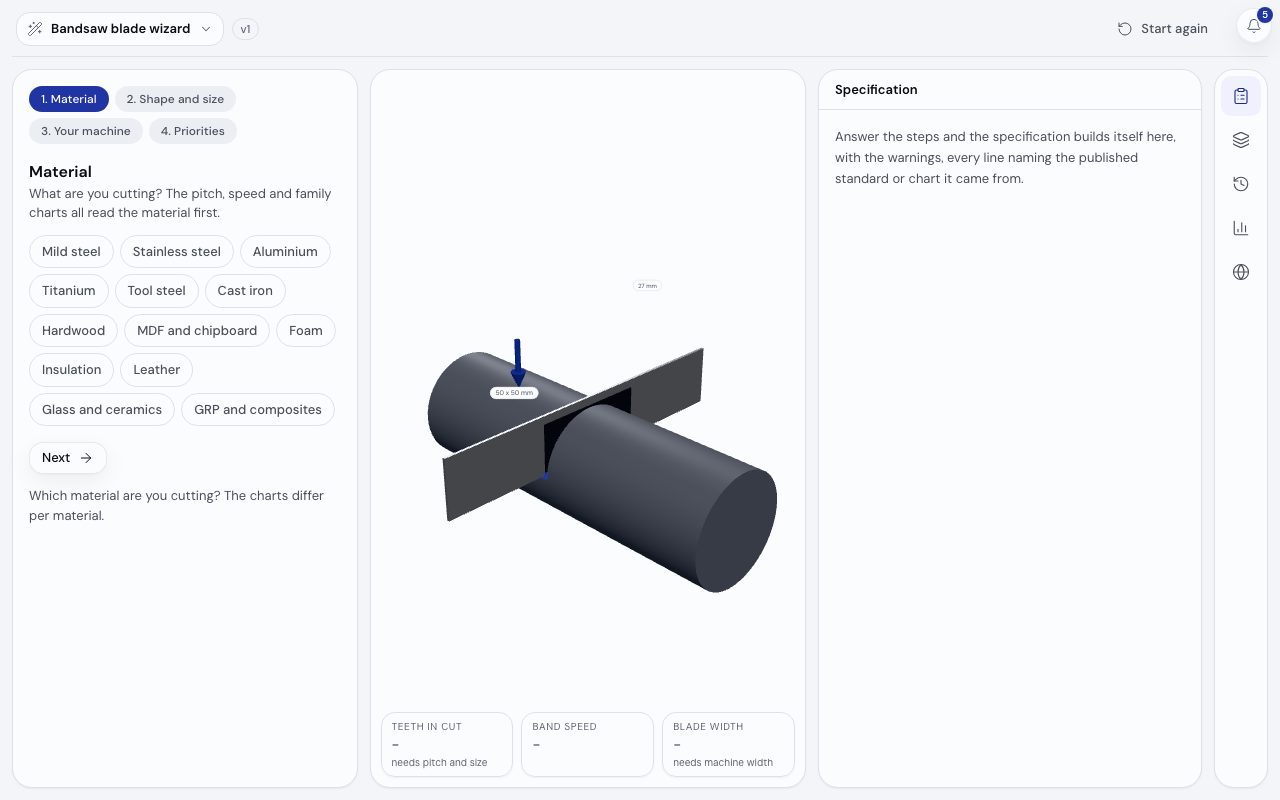
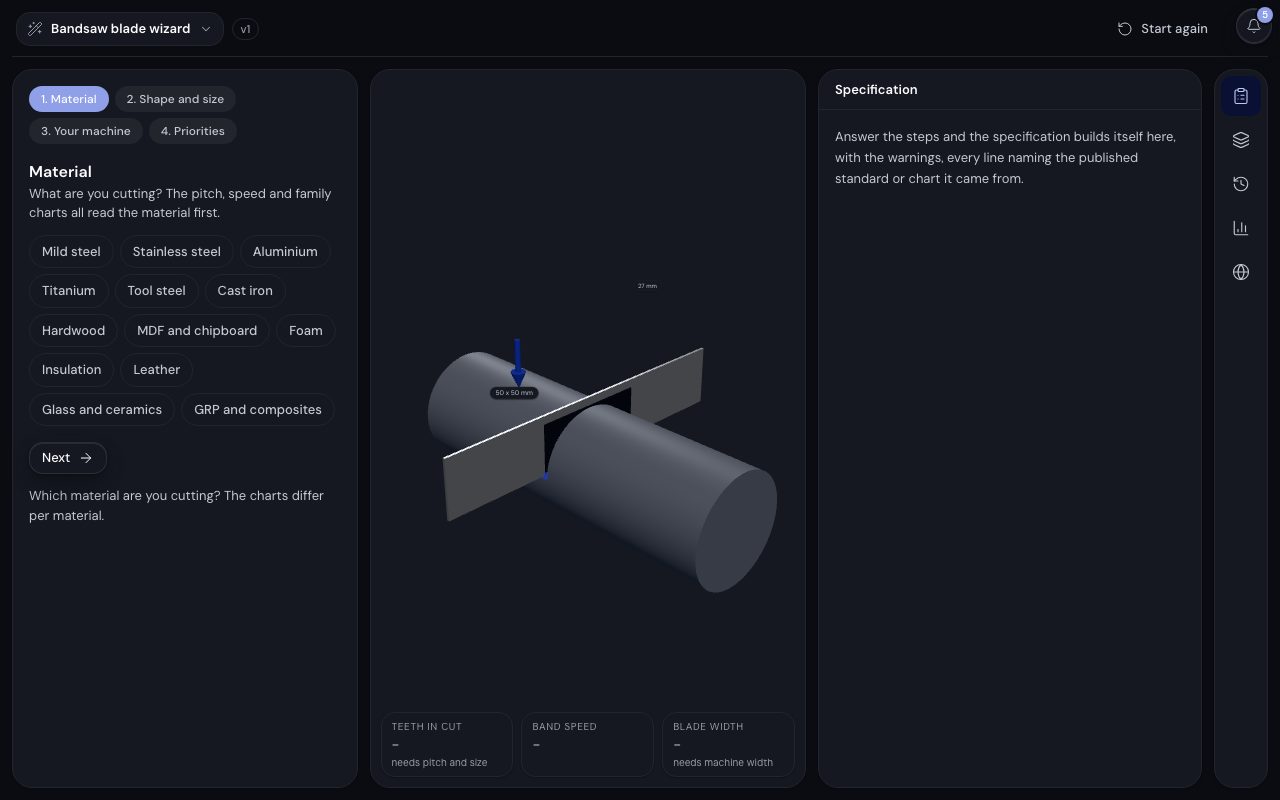
/app/wizard/bandsaw-blade, demonstration data, captured 23 September 2026. Open full sizeOpen full sizeEvery value is a published starting point, tuned at the machine. Outside a table the wizard says so.
Materials
Thirteen materials drive the blade family and the speed. Stainless asks its grade and tool steel its condition, as the charts split on them.
| Material | Blade families, ranked | Note |
|---|---|---|
| Mild steel | Bi-metal (M42 tooth edge); Carbide tipped (TCT) | Bi-metal M42 carries general mild steel work; carbide earns its keep on high production. |
| Stainless steel | Bi-metal (M42 tooth edge); Carbide tipped (TCT) | Bi-metal M42 first; carbide offered for production runs. |
| Aluminium | Bi-metal (M42 tooth edge); Carbide tipped (TCT) | Bi-metal covers general aluminium; carbide for production on purpose built saws. |
| Titanium | Bi-metal, high tier (M51 class production ranges); Carbide tipped (TCT) | High tier bi-metal (M51 class) first, then carbide. |
| Tool steel | Bi-metal (M42 tooth edge); Carbide tipped (TCT) | Annealed tool steel cuts on bi-metal; hardened tool steel needs carbide. |
| Cast iron | Bi-metal (M42 tooth edge); Carbide tipped (TCT) | Bi-metal for machined iron; carbide for scale and chill. |
| Hardwood | Carbon steel (flexback and hardback); Sawmill and resaw; Bi-metal (M42 tooth edge) | Carbon for general work, resaw bands for deep sections, bi-metal wood ranges for abrasive or reclaimed timber. |
| MDF and chipboard | Carbon steel (flexback and hardback) | Carbon fine pitch for man made board. |
| Foam | Bandknife | Knife edges: straight, wavy or scallop. No teeth. |
| Insulation | Bandknife | Knife edges: straight, wavy or scallop. No teeth. |
| Leather | Bandknife | Knife edges: straight, wavy or scallop. No teeth. |
| Glass and ceramics | Grit and diamond | Grit and diamond only; no conventional teeth. |
| GRP and composites | Grit and diamond | Grit and diamond, including carbide grit ranges. Dust extraction required. |
Family branches follow the Addler hardness tiers and the Dakin-Flathers M42 and M51 guidance, accessed 2026-07-28.
Pitch for solid sections
The engaged width picks the band whose centre is nearest, then the nearest standard pitch. The why line says which.
| Section width | TPI |
|---|---|
| 0-5 mm | 18 |
| 4-8 mm | 14 |
| 2-15 mm | 10/14 |
| 8-20 mm | 8/12 |
| 16-30 mm | 6/10 |
| 25-40 mm | 5/8 |
| 35-70 mm | 4/6 |
| 60-120 mm | 3/4 |
| 80-200 mm | 2/3 |
| 120-400 mm | 1.5/2 |
| 250 mm and up | 1.1/1.6 |
| 400 mm and up | 0.75/1.25 |
Source: Addler (Excision) bandsaw blade tooth selection guide, accessed 2026-07-28.
Pitch for tubes, pipes and profiles
Rows are section width W, columns wall thickness T, both in mm; cells are TPI. An empty cell is outside the chart, and the wizard says so.
| W (section) | T 1 | T 1.6 | T 2 | T 2.5 | T 3 | T 4 | T 5 | T 6 | T 7 | T 8 | T 9 | T 10 | T 12 | T 15 | T 20 | T 50 |
|---|---|---|---|---|---|---|---|---|---|---|---|---|---|---|---|---|
| 10 mm | 14 | 10/14 | 10/14 | |||||||||||||
| 20 mm | 14 | 10/14 | 10/14 | 10/14 | 8/12 | |||||||||||
| 25 mm | 14 | 10/14 | 10/14 | 10/14 | 8/12 | 8/12 | ||||||||||
| 30 mm | 14 | 10/14 | 10/14 | 10/14 | 8/12 | 8/12 | 6/10 | |||||||||
| 40 mm | 14 | 10/14 | 10/14 | 10/14 | 8/12 | 8/12 | 6/10 | 5/8 | 5/8 | 5/8 | ||||||
| 50 mm | 14 | 10/14 | 10/14 | 8/12 | 8/12 | 6/10 | 6/10 | 5/8 | 5/8 | 5/8 | ||||||
| 60 to 120 mm | 14 | 10/14 | 10/14 | 8/12 | 8/12 | 6/10 | 6/10 | 5/8 | 5/8 | 4/6 | 4/6 | 4/6 | 4/6 | 3/4 | 3/4 | |
| 130 to 150 mm | 10/14 | 10/14 | 8/12 | 8/12 | 6/10 | 6/10 | 5/8 | 5/8 | 4/6 | 4/6 | 4/6 | 4/6 | 3/4 | 3/4 | 3/4 | |
| 150 to 180 mm | 10/14 | 8/12 | 6/10 | 6/10 | 5/8 | 4/6 | 4/6 | 4/6 | 4/6 | 4/6 | 4/6 | 3/4 | 3/4 | 3/4 | ||
| 190 to 300 mm | 6/10 | 6/10 | 5/8 | 4/6 | 4/6 | 4/6 | 4/6 | 4/6 | 4/6 | 3/4 | 3/4 | 2/3 | ||||
| 350 to 400 mm | 4/6 | 4/6 | 3/4 | 3/4 | 3/4 | 3/4 | 2/3 | |||||||||
| 450 to 500 mm | 4/6 | 4/6 | 3/4 | 3/4 | 3/4 | 3/4 | 2/3 |
Source: Addler (Excision) tooth selection guide, corroborated by the Shark Bandsaw Blades UK wall by diameter matrix, accessed 2026-07-28.
Blade width and minimum contour radius
Straight cuts want the widest blade the machine takes; contour cuts the widest that still turns the radius.
| Blade width | Minimum radius |
|---|---|
| 3 mm (1/8") | 5 mm (3/16") |
| 5 mm (3/16") | 8 mm (5/16") |
| 6 mm (1/4") | 16 mm (5/8") |
| 10 mm (3/8") | 38 mm (1 1/2") |
| 13 mm (1/2") | 64 mm (2 1/2") |
| 19 mm (3/4") | 140 mm (5 1/2") |
| 25 mm (1") | 180 mm (7") |
Source: Ravenview bandsaw blade radius chart, corroborated by the Dakin-Flathers width guide, accessed 2026-07-28.
Band speed starting ranges
Metres per minute, bi-metal blades unless noted. Silver curled chips are right, powdery chips mean feed too low, blue chips mean speed or feed too high.
| Material group | Start range m/min | Notes |
|---|---|---|
| Free machining steels (EN1A, 12L14, 1215) | 90 to 105 | |
| Low carbon and structural (S275, A36, EN3, 1018) | 60 to 80 | |
| Medium carbon (EN8, 1045) | 60 to 72 | |
| High carbon (EN42, 1080, 1095) | 50 to 60 | |
| Alloy steels (EN19, 4140 class) | 50 to 70 | |
| Bearing and spring (52100, 6150, 5160) | 45 to 60 | |
| Stainless austenitic 304 | 30 to 45 | |
| Stainless 316 and duplex | 25 to 40 | Start at the lower end of the range. |
| Tool steels annealed (D2, H13, O1) | 20 to 40 | |
| Hardened steel above 45 HRC | 20 to 40 | Cut with carbide only and follow the blade maker. |
| Grey cast iron | 40 to 60 | Can be cut dry. |
| Aluminium alloys | 80 to 300 | The top of the range is machine dependent: 84 to 104 m/min is a conservative bi-metal production range, and carbide on a purpose built saw runs far higher. |
| Copper | 60 to 90 | |
| Brass | 65 to 110 | |
| Bronze alloys | 35 to 90 | Depends on the alloy. |
| Titanium | 15 to 25 | |
| Nickel superalloys (Inconel, Hastelloy) | 10 to 20 | Carbide preferred, on a rigid setup. |
| Wood on carbon blades | see note | Follow the machine plate. Woodworking band speeds run far higher than metal, typically tens of metres a second. |
| Glass, ceramics and composites on grit bands | see note | Run a low band speed for the machine and follow the blade maker. |
Source: Blade Serpent per alloy speed chart and the Emin Academy family chart, accessed 2026-07-28.
Wood pitch guidance
Each depth takes the coarsest standard pitch inside the Dakin-Flathers rule of three to six teeth in the workpiece.
| Depth of cut | TPI |
|---|---|
| under 15 mm | 10 to 14 (finish work and tearout control) |
| 15-40 mm | 6 to 8 |
| 40-90 mm | 4 to 6 |
| 90-180 mm | 3 to 4 |
| over 180 mm | 3 (or a dedicated resaw or sawmill band where the machine takes 27 mm and up) |
Source: derived from the Dakin-Flathers teeth per inch rule, accessed 2026-07-28.
Other sources
Blade break in follows Starrett, corroborated by Cutting Tool Engineering and Canadian Metalworking. Radius cutting practice follows Saw Service of Washington.
Related
- WizardWizard picks the right product for the application, the way an application engineer would.
- The PCD saw blade selectorSpecify a diamond tipped circular blade from the machine, the material and the cut quality, with every line naming its table.
- WizardRun a wizard, read its specification and see where it is embedded.